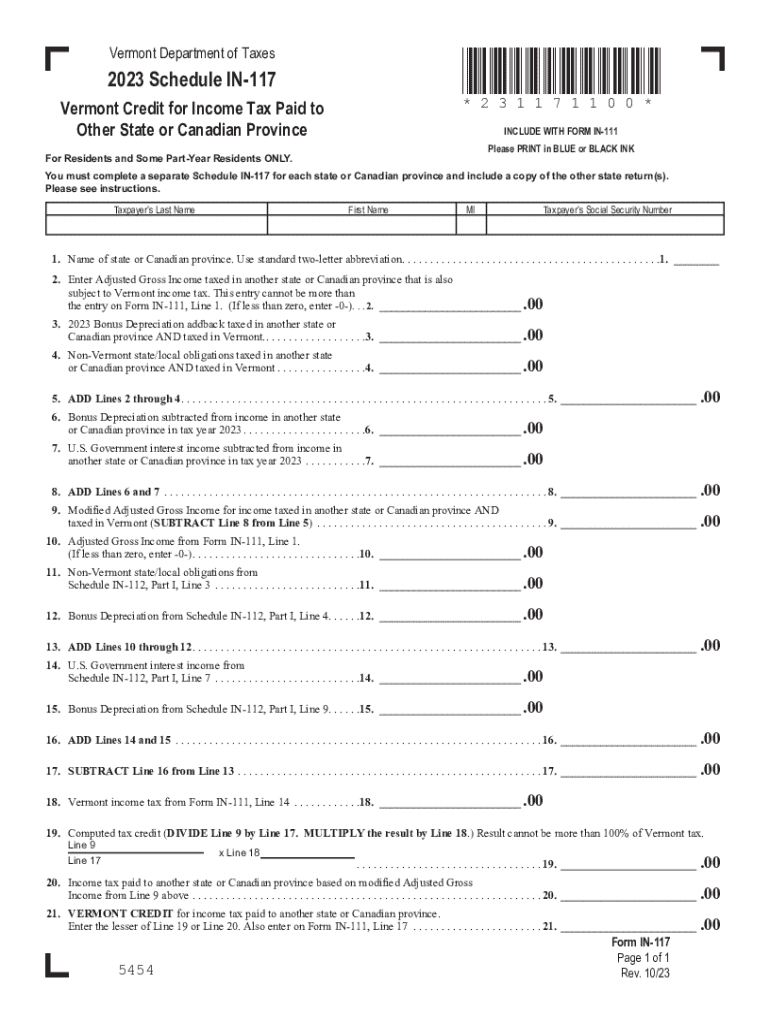
Vermont Department Of Taxes2023 Schedule IN117*231 Form
Use a Vermont Department Of Taxes2023 Schedule IN117*231 template to make your document workflow more streamlined.
What this Vermont tax schedule is
The Vermont Department Of Taxes2023 Schedule IN117*231 Form is a Vermont tax schedule identified by the 2023 filing year and IN117*231 form code. It is used to organize the state tax information requested by the Vermont Department of Taxes and support a taxpayer’s filing records. In signNow, a preparer can upload the schedule, review detected fields, assign signer fields, and send it for electronic completion. After signing, the completed form and audit trail can be downloaded together. The schedule’s official instructions and Vermont filing requirements control its substantive use.
Business types using this Vermont schedule
The form is most useful where Vermont tax information must move between preparers, taxpayers, and authorized reviewers with an organized signature record.
Independent Vermont tax preparers can use the schedule as a controlled client document, sending a prepared copy for review and signature while keeping the final form and audit trail organized with the client’s state tax records. Small Vermont businesses can route the schedule between an owner, bookkeeper, and tax professional, reducing email attachments and maintaining a clear completion record for the business’s filing documentation. Multi-location accounting departments can standardize the schedule workflow with shared templates, delegated sending, and role-based access, helping separate preparation duties from approval and preserving consistent records across offices.
These tasks are executed by both individual contributors and centralized administrators depending on organizational policy and required controls.
Who uses this Vermont tax schedule
Financial services
Financial services teams use this Vermont tax schedule to collect taxpayer information, verify entries, and preserve signed records for review. signNow supports reusable templates, signer routing, and an audit trail that records document activity without changing the form’s required information.
Tax professionals
Vermont businesses and tax professionals use the schedule when preparing state tax documentation, coordinating taxpayer review, and retaining completed copies. signNow helps gather signatures remotely while keeping the original form, completion record, and signer activity together.
How the Vermont schedule workflow works
Complete the Vermont Department Of Taxes2023 Schedule IN117*231 Form by checking the applicable tax information, routing it to the right signer, and preserving the finished record.
Confirm the form: Start with the official Vermont tax schedule and confirm the applicable tax year. Upload and review: Upload the form to signNow and review detected fields before editing. Route for signing: Assign required fields, then send the prepared document to authorized signers. Store the record: Download the completed copy and retain its audit trail with tax records.
Complete the Vermont schedule in signNow
Follow these steps to prepare the Vermont Department Of Taxes2023 Schedule IN117*231 Form, collect the required signature, and retain the completed record.
Upload form:
Upload the official Vermont schedule into signNow. Check fields:
Review detected fields and add missing signer fields. Send document:
Enter signer details and send the schedule securely. Sign form:
Review, sign, and complete the Vermont schedule. Archive records:
Download the signed form and audit trail.
 Best ROI. Our customers achieve an average 7x ROI within the first six months.
 Scales with your use cases. From SMBs to mid-market, airSlate SignNow delivers results for businesses of all sizes.
 Intuitive UI and API. Sign and send documents from your apps in minutes.
What the Vermont schedule audit trail records
The audit trail documents how the Vermont schedule moved from preparation through signature, creating a reviewable record separate from the tax information itself.
Authenticate signer:
Capture timestamp:
Hash document:
Seal record:
Track activity:
Retrieve audit trail:
Recommended Vermont schedule setup
Use a controlled signing configuration that separates preparation, review, signature, access, and retention responsibilities for the Vermont schedule.
| Setting | Recommendation |
|---|---|
| Authentication and signature method | Email signing with SMS OTP for sensitive records |
| Audit trail | Export completion certificate with signed schedule |
| Document retention | Three years from filing under IRC §6501(a) |
| Encryption | TLS 1.2/1.3 in transit and AES-256 at rest |
| User provisioning | Assign preparer and reviewer access by role |
Mobile options for Vermont schedule signing
The signNow mobile apps for iOS and Android let authorized users review the Vermont Department Of Taxes2023 Schedule IN117*231 Form away from a desk. Camera-based capture can import a paper copy for preparation, while mobile signing supports a controlled electronic workflow.
iOS app iOS app supports mobile Vermont schedule review and signing Android app Android app supports field completion and signatures Camera capture Camera capture imports paper tax schedules for preparation
Organizations should manage mobile access through approved devices and user permissions. Before relying on offline work, confirm the app’s current behavior and synchronize completed records when connectivity returns. Retain the signed Vermont schedule and its audit trail in the organization’s designated tax-record repository.
Signer authentication and certificates
PKI:
X.509 certificates:
Two-factor authentication:
SMS OTP:
ID verification:
Audit trail:
Challenges with the Vermont schedule
Incorrect taxpayer information can make a signed Vermont schedule inaccurate even when the signature event and audit trail are complete. Using an outdated Vermont schedule version may create mismatched fields, missing information, or filing complications during tax-document review. Sending the schedule to the wrong signer can delay completion and weaken internal evidence that an authorized person approved the submitted information. Emailing completed tax schedules without controlled access can expose personal information beyond the preparer, taxpayer, and authorized reviewer.
Best practices for this Vermont schedule
Accuracy comes first: prepare the Vermont schedule from source records, then use signNow to control signing, document the process, and preserve the completed file.
Confirm the official Vermont schedule version
Assign fields to the correct signer
Preserve the signed schedule and audit trail
Check every entry before filing
Retention periods for tax records
Retain the completed Vermont schedule according to the underlying tax-record category, the filing circumstances, and any longer Vermont requirement that applies.
Three years from filing
Six years for major understatement
Indefinite for fraud
Indefinite without return
Vermont-specific period
Legal standing of the Vermont schedule
A completed Vermont Department Of Taxes2023 Schedule IN117*231 Form may carry evidentiary value when the signer shows intent, consents to electronic records, can be attributed to the signature, and the record remains reproducible under ESIGN, 15 U.S.C. ch. 96, and applicable Vermont electronic-transactions law. Wills, court orders, and certain family-law documents remain excluded.



Managing Vermont schedule access
Administrators can prepare shared signNow templates for the Vermont schedule, define who may edit or send them, and separate preparation from approval. Shared templates reduce uncontrolled copies while keeping the official schedule’s fields visible for review before sending to taxpayers or authorized representatives.— Auditable delegation: Admin controls preserve responsibility boundaries while the audit trail records document actions and completion history for later tax-record review, without treating signNow as the Vermont Department of Taxes authority or filing system position. Spaces? Actually this is too long 57? Need 30-50. We'll fix below. Delegated senders can route a prepared Vermont schedule without changing the organization’s access policy. Role-based permissions help limit personal tax information to assigned users, while the completion certificate and audit trail remain available to authorized administrators for retention and review.
Troubleshooting the Vermont schedule workflow
These answers address field detection, signer routing, authentication, retention, and legal-use questions that arise when handling this Vermont tax schedule in signNow.
Upload the official Vermont schedule as a PDF or supported document, then inspect signNow’s detected fields before sending. Automatic field detection can assist with placement, but the sender remains responsible for confirming every required field and signer assignment on this specific tax schedule.
The signNow Business plan is listed at $8 per user per month with annual billing and includes templates and audit trails. It includes 100 signature invites per user per year; additional invites may incur overage fees, so review usage before routing repeated Vermont schedules.
For a Vermont tax document containing personal information, use signNow access controls and an appropriate signer-authentication method. signNow states that its ESIGN and UETA compliance supports electronic signatures, while Vermont tax filing rules still determine how the completed schedule must be submitted.
If the Vermont schedule requires a taxpayer review before signing, configure the recipient order so the preparer does not sign prematurely. signNow’s routing and audit trail can show each action, but they cannot replace the department’s substantive requirements for accurate tax information.
Export the completed Vermont schedule and the signNow audit trail after all signers finish. Store the documents together with the applicable tax records. Federal tax-record retention depends on the underlying record, including three years under IRC §6501(a) in the general case.
If a signer cannot open the Vermont schedule, confirm the email address, resend the invitation, or provide a controlled signNow signing link. For consumer-facing electronic records, review the ESIGN Act disclosure requirements in 15 U.S.C. §7001(c) before relying on electronic delivery.
Key performance indicators that demonstrate SignNow's proven track record.
BE READY TO GET MORE
Get this form now!

If you believe that this page should be taken down, please follow our DMCA take-down process.