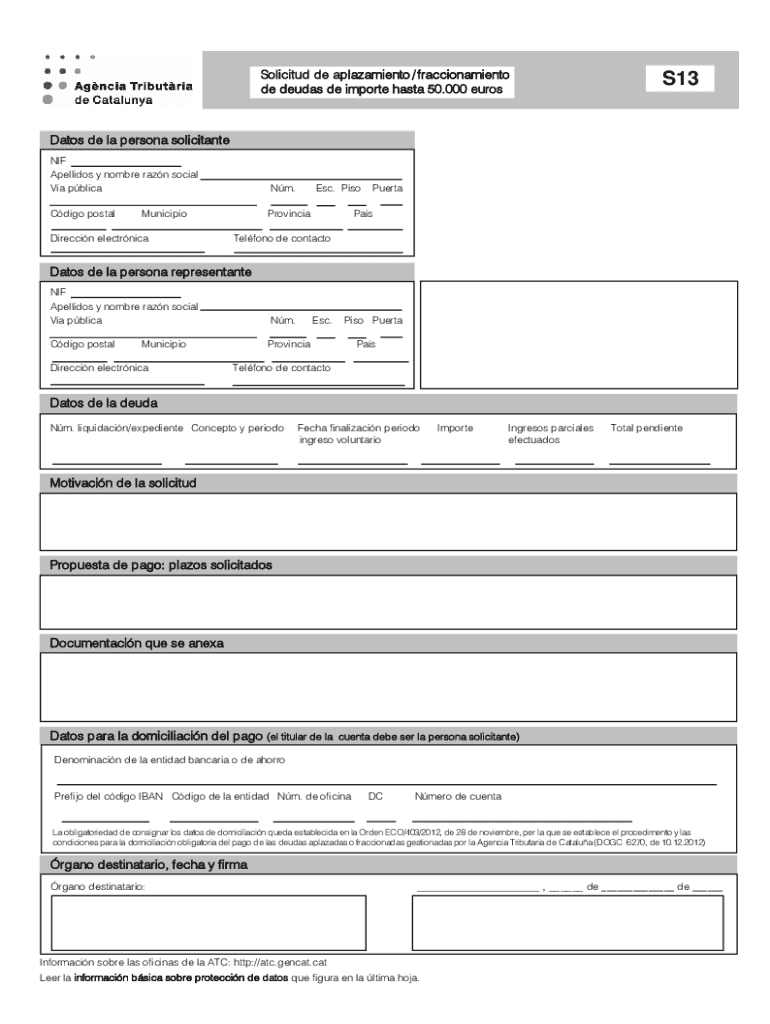
Debt deferral and installment application form
Use a Solicitud De Aplazamiento Fraccionamiento De Deudas template to make your document workflow more streamlined.
What this debt application does
The Solicitud DE Aplazamiento Fraccionamiento DE Deudas Form is an application for asking a creditor or public authority to postpone debt payment or divide the balance into installments. It records the applicant’s identity, debt information, requested arrangement, supporting explanation, and approval signatures. In signNow, the form can be uploaded, reviewed for fillable fields, completed electronically, routed to designated signers, and retained with an audit trail. The form itself does not guarantee approval; the receiving authority decides whether the proposed deferral or installment plan is accepted.
Who uses this debt application
Debtors and owners
A debtor or business owner uses the form to identify the debt, explain the requested postponement or installment schedule, and authorize submission. Finance staff can prepare the record, while the responsible individual reviews the balance, proposed dates, and payment terms before signing.
Finance teams
Accounting and collections teams use the application to coordinate supporting records, route it to authorized signers, and preserve the completed request. The workflow is useful when several people review the debt but only designated representatives may approve or submit the arrangement.
Key benefits of this debt application
This form organizes a request to defer or divide debt payments, while signNow adds structured completion, signature routing, and retrievable evidence.
Structured completion
Complete the debt deferral and installment request in a structured digital document, reducing omitted details and making payment terms easier to review before submission.
Signature routing
Route the completed application to the responsible parties for electronic signatures, keeping the request organized instead of relying on separate email attachments.
Audit evidence
Capture signer actions, timestamps, and document history in an audit trail that helps demonstrate how the application was completed and approved.
Reusable templates
Use reusable templates for recurring debt-relief requests, preserving required fields and payment-plan details across applications handled by the same team.
Centralized records
Keep the signed application and completion record together in signNow, making later retrieval easier when confirming agreed deferral or installment terms.
Workflow connections
Connect the workflow with supported business systems so application data and signed records can move into established finance or document-management processes.
How the debt application workflow works
The digital workflow moves the application from preparation through approval and preserves the signed record for later reference.
Upload the form: Upload the debt application and review its fields. Complete details: Add missing fields for debt, dates, and payment terms. Request signatures: Send the application to authorized signers by email. Archive the record: Store the signed form with its audit trail.
 Best ROI. Our customers achieve an average 7x ROI within the first six months.
 Scales with your use cases. From SMBs to mid-market, airSlate SignNow delivers results for businesses of all sizes.
 Intuitive UI and API. Sign and send documents from your apps in minutes.
Platform requirements for this form
Complete the debt deferral and installment application through Chrome, Firefox, Safari, or Edge on Windows 10, macOS, iOS, or Android. signNow encrypts data in transit with TLS 1.2 or TLS 1.3, while its mobile apps support document review and signing on iOS and Android devices.
Browsers Chrome, Firefox, Safari, and Edge Operating systems Windows 10, macOS, iOS, and Android Secure connection TLS 1.2 or 1.3 connection
Organizations should also review managed-device policies before sending this application. Enterprise deployments may require API access, SSO provisioning, controlled user permissions, and certificate or long-term validation settings. Configure those controls according to the organization’s finance, privacy, and records-management requirements before collecting signatures.
Legal standing of the signed application
A signed debt deferral or installment application can support a U.S. business record when the parties show intent, consent, attribution, and reliable retention under ESIGN, 15 U.S.C. ch. 96, and applicable state law such as UETA. Those rules do not generally cover wills, codicils, certain court orders, or family-law decrees.

What the audit trail records
The audit trail separates signing evidence from the form’s payment information and shows how the completed application moved through review.
Authenticate signer:
Capture timestamp:
Hash document:
Seal record:
Log field actions:
Export evidence:
Security for signed debt records
Encryption at rest:
Transport encryption:
Security certification:
Information security:
Electronic signatures:
Protected information:
Recommended setup for this application
Use a controlled signing workflow that matches the application’s financial information, signer authority, and applicable records requirements.
| Setting | Recommendation |
|---|---|
| Authentication method | Email verification with SMS OTP |
| Signature type | Typed or drawn electronic signature |
| Audit trail | Export with completed application |
| Document retention | Three years from filing under IRC §6501(a) |
| Encryption | AES-256 at rest and TLS 1.2 or 1.3 |
Record-keeping practices for debt applications
Preserve the application, signature evidence, and payment-plan history together, using the applicable tax, contract, and state-records requirements.
Apply the correct retention period
Export the audit trail
Secure the archived record
Document jurisdictional requirements
Challenges when completing the application
Applicants may enter an incorrect balance or account reference, making the requested deferral or installment schedule difficult for the receiving authority to reconcile. Missing income, expense, or payment-plan information can delay review because the authority lacks facts needed to evaluate the requested debt arrangement. A signature from an unauthorized representative may weaken attribution and require the application to be resubmitted by the responsible debtor or officer. Uploading an outdated version can omit required fields or current payment terms, creating inconsistencies between the application and supporting debt records.
Pricing for debt application workflows
signNow’s verified plan details are shown first; competitor pricing and feature availability are marked Not verified where the supplied reference does not provide figures.
| Features | signNow | DocuSign | Adobe Sign | PandaDoc |
|---|---|---|---|---|
| Starting price | $8/user/month annually | Not verified | Not verified | Not verified |
| Free trial | 7 days, no card | Not verified | Not verified | Not verified |
| Bulk send | Business Premium | Not verified | Not verified | Not verified |
| Audit trails | Business plan included | Not verified | Not verified | Not verified |
Troubleshooting this debt application
These answers address field detection, signing, compliance, plan limits, and record handling for the debt deferral and installment application.
Upload the debt form as a PDF, then use signNow’s field tools to review detected fields and add missing text, date, initials, and signature fields. Confirm that balance, creditor, applicant, and requested installment terms remain visible before sending.
The Business plan includes templates, audit trails, and legally binding eSignatures at $8 per user per month with annual billing. It does not include bulk send; signNow lists bulk send under Business Premium at $15 per user per month annually.
Use signNow’s audit trail and completion record to preserve signer actions, timestamps, and document history. Legal effect still depends on intent, consent, attribution, and record retention under ESIGN and applicable state law, including UETA or New York ESRA.
For consumer-facing electronic records, review the ESIGN consumer-disclosure requirements in 15 U.S.C. §7001(c), including paper-record rights and electronic-access capability. Configure the process so the applicant can review and retain the completed application.
Business Premium adds bulk send and costs $15 per user per month with annual billing; Business costs $8. If many debt applications use the same template, choose the plan based on sending volume and required controls rather than assuming every plan includes bulk send.
If a signer cannot open the invitation, verify the email address, resend the request, or provide a controlled signing link. For stronger attribution, configure available authentication options and ensure the final audit trail remains attached to the signed application.
Key performance indicators that demonstrate SignNow's proven track record.
BE READY TO GET MORE
Get this form now!

If you believe that this page should be taken down, please follow our DMCA take-down process.