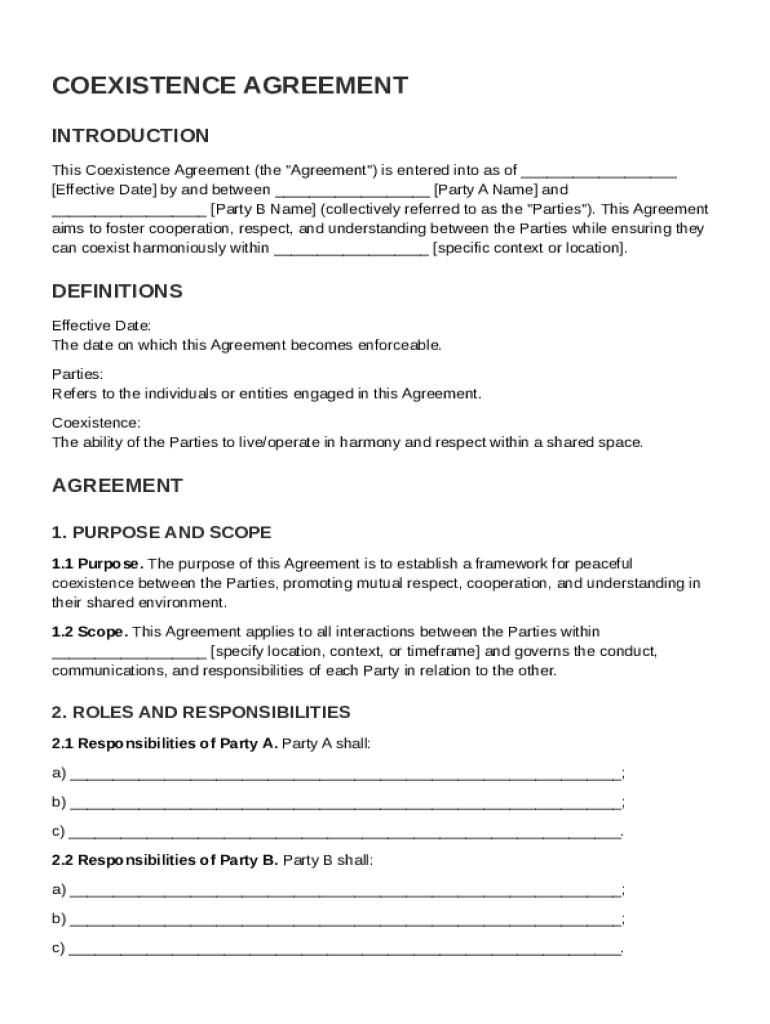
Coexistence Agreement Form
Use a Coexistence Agreement Template template to make your document workflow more streamlined.
What a coexistence agreement does
A Coexistence Agreement Form is a written contract in which two businesses define how they may use similar names or marks without challenging agreed commercial activity. It identifies the parties, covered marks or names, goods and services, territories, channels, permissions, restrictions, and signatures. The parties should tailor those terms to their negotiated arrangement and applicable trademark law. After upload, signNow can help place fields, route the agreement to authorized representatives, capture electronic signatures, and preserve the completed document with an audit trail. ESIGN and UETA generally support electronic execution when their requirements are satisfied.
Who uses this form and why
Small businesses
A small business owner or trademark counsel can use the form for a written coexistence arrangement covering business names, marks, goods, services, territories, and communication channels. The completed record supports coordinated market activity while preserving each party’s stated rights and restrictions.
Enterprise teams
In-house legal, brand, and commercial teams can use the form for negotiated agreements between established businesses. SignNow supports sequential routing, electronic signatures, audit trails, and controlled storage for contracts that require review by multiple authorized representatives.
Businesses that use coexistence agreements
Businesses use this form when two parties need written, enforceable boundaries for operating under similar names or marks in defined commercial settings.
Solo trademark consultants can prepare a Coexistence Agreement Form for two closely held businesses, define market boundaries, and collect authorized signatures without coordinating paper exchanges. Regional retailers and service companies can document negotiated limits on names, territories, and customer channels before expanding, giving marketing and legal teams one signed operating reference. Enterprise legal departments can route agreements through controlled signer workflows, preserve audit trails, and connect completed records with systems used for brand governance and contract administration.
These tasks are executed by both individual contributors and centralized administrators depending on organizational policy and required controls.
Features that support clear coexistence terms
A carefully completed Coexistence Agreement Form turns negotiated brand boundaries into a signed, searchable record for both businesses.
Define boundaries
Define the two businesses, marks, goods, services, territories, and channels that may coexist. Clear boundaries reduce ambiguity and help reviewers understand precisely what each party promises not to challenge.
Identify parties
Record each party’s legal name, address, and authorized signer. Accurate identity details connect the signed agreement to the businesses making the commitments and support later authentication.
Set permissions
Specify permitted branding and market activity in writing. Detailed limitations give both businesses an operational reference when launching products, advertising, or entering new territories.
Route signatures
Use ordered signing fields for authorized representatives. SignNow routes the agreement to the correct parties and records each action, reducing missed signatures and manual follow-up.
Capture consent
Capture consent to electronic records where required. An accessible signed copy and completion certificate help demonstrate intent, attribution, and reliable record retention under ESIGN and UETA.
Preserve evidence
Store the completed agreement with its audit trail. A controlled record helps legal and commercial teams retrieve the exact terms when reviewing branding or market-expansion decisions.
 Best ROI. Our customers achieve an average 7x ROI within the first six months.
 Scales with your use cases. From SMBs to mid-market, airSlate SignNow delivers results for businesses of all sizes.
 Intuitive UI and API. Sign and send documents from your apps in minutes.
How this coexistence form works
The signNow workflow converts negotiated coexistence terms into a controlled electronic signing record without changing the agreement’s substantive obligations.
Upload document: Upload the agreement and review detected fields. Assign parties: Assign each field to the correct representative. Route signing: Send the defined terms for electronic signature. Preserve record: Store the signed agreement with its audit trail.
Steps to complete the form
Prepare the negotiated terms first, then use signNow to configure fields, route the agreement, and preserve evidence of completion.
Upload form:
Upload the completed Coexistence Agreement Form to signNow. Check fields:
Review detected fields and add missing signature or date fields. Assign signers:
Assign fields to each authorized business representative. Send agreement:
Send the agreement and monitor completion status.
Processing stages for a coexistence agreement
Use a defined sequence so the Coexistence Agreement Form is accurate, properly authorized, and retrievable after every signature.
Prepare agreement
Deliver to signers
Review and sign
Archive completed record
Challenges when preparing coexistence terms
Leaving the parties’ legal names or trademark descriptions incomplete can make the agreement difficult to attribute and interpret. Describing territories, product categories, or sales channels vaguely may create disputes about whether later activity falls within the agreed boundaries. Sending the agreement without confirming signer authority can weaken evidence that each business intended to accept the stated restrictions. Failing to preserve the signed document and audit trail makes it harder to establish the exact terms later.
Security controls for signed agreements
Transport encryption:
Storage encryption:
Security certification:
Information security:
Electronic records:
Privacy controls:
Best practices for this agreement
Precision before signing matters because the form’s value depends on clear party identity, defined commercial boundaries, and reliable evidence of acceptance.
Verify parties and marks
Write measurable boundaries
Control signer routing
Protect the final record
Recommended setup for this form
Use controlled identity, signature, audit, retention, and encryption choices when preparing a Coexistence Agreement Form for business records.
| Setting | Recommendation |
|---|---|
| Authentication method | Email verification with stronger controls as needed |
| Signature type | Electronic signature with recorded signer intent |
| Audit trail | Enabled with timestamps and document history |
| Document retention | Retain under the organization’s contract policy |
| Encryption | TLS 1.2/1.3 and AES-256 protection |
Questions about completing and signing
These answers address document preparation, signer controls, electronic-signature evidence, and signNow plan features relevant to a Coexistence Agreement Form.
Upload the agreement as a PDF or supported document, then use signNow’s field tools to place signature, date, and required information fields. Review every field against the negotiated party names, marks, territories, and restrictions before sending.
The Business plan includes templates and audit trails, while Business Premium adds bulk send. For one Coexistence Agreement Form, upload or prepare the document, assign each signer, and route it individually rather than using bulk delivery.
ESIGN and UETA generally recognize electronic records and signatures when intent, consent, attribution, and record retention requirements are met. For consumer-facing transactions, review the ESIGN disclosure requirements in 15 U.S.C. §7001(c).
Use signNow’s signer authentication options when the agreement requires stronger identity evidence. Advanced signer authentication is listed for Enterprise; select the control that matches the parties’ risk and internal policy.
SignNow records timestamps, actions, and document history in the audit trail. Preserve the completed agreement and its audit trail together so the parties can show which version was signed and when.
A coexistence agreement does not replace legal review of trademark scope or state requirements. ESIGN and UETA do not remove statutory exclusions such as wills, court orders, and family law decrees.
Key performance indicators that demonstrate SignNow's proven track record.
BE READY TO GET MORE
Get this form now!

If you believe that this page should be taken down, please follow our DMCA take-down process.