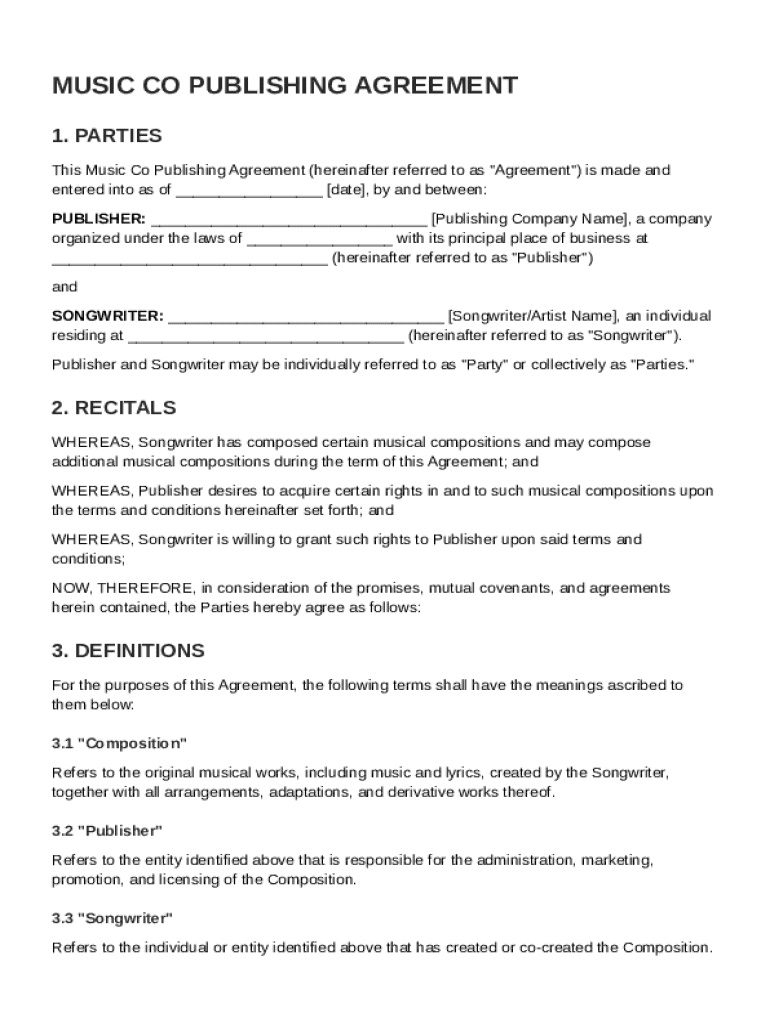
Music Co Publishing Agreement Form
Use a Music Co Publishing Agreement Template template to make your document workflow more streamlined.
What the Music Co Publishing Agreement Form does
The Music Co Publishing Agreement Form records how co-publishing rights, ownership shares, royalties, responsibilities, and approvals are allocated between music collaborators. It gives songwriters, publishers, and business representatives one document to review and sign before the publishing relationship begins. With signNow, upload the agreement, place or detect fields, assign each signer, and send it electronically. Signers review the defined terms, complete required fields, and apply their signatures. The completed agreement and audit trail can then be stored for business records, subject to the parties’ contract and applicable state law.
Who benefits from music publishing agreements
The form is useful wherever multiple parties need a clear, signed record of publishing rights, financial participation, and responsibilities.
Independent songwriters and small publishing partnerships can use the form to document each contributor’s ownership percentage, royalty allocation, approval rights, and responsibilities before distributing or licensing a work. Music publishers and entertainment-law teams can route standardized agreements to multiple collaborators, preserve amendments, and retain signer evidence while managing terms across catalogs, co-writers, and business representatives. Larger music companies can connect reusable agreement templates with controlled user access, delegated sending, and audit trails for repeatable publishing operations involving many works and counterparties.
These tasks are executed by both individual contributors and centralized administrators depending on organizational policy and required controls.
Who uses this music agreement
Songwriters and publishers
Songwriters and co-publishers use the form to document ownership shares, royalty allocations, work identification, approval rights, and obligations before licensing or exploiting a musical work.
Music businesses and counsel
Music companies and legal teams use it for repeatable contract routing, signer tracking, amendments, and secure retention of executed publishing records across projects and catalogs.
Key features for music publishing agreements
signNow connects the agreement’s parties, signature fields, completion evidence, and final record without changing the commercial terms negotiated by the collaborators.
Field placement
Upload the agreement and place signer, date, initials, and approval fields without rebuilding the publishing document from scratch.
Signer routing
Route ownership and royalty terms to each songwriter, publisher, or representative in the required signing order.
Signing evidence
Collect signatures electronically while preserving intent, signer identity, timestamps, and document history for later review.
Reusable templates
Use reusable templates for recurring co-publishing agreements while updating the parties, works, shares, and effective dates.
Status tracking
Review completion status from a central workspace instead of coordinating separate email attachments and handwritten pages.
Record continuity
Store the executed agreement with its audit trail so amendments and payment-related terms remain traceable.
How the music agreement workflow works
The process moves from approved commercial terms to assigned signers, completed signatures, and an evidence-backed business record.
Prepare document: Upload the approved agreement and identify required fields. Set signer roles: Assign each publishing participant a signer role. Route agreement: Send the agreement through signNow for review. Preserve evidence: Store the signed record and audit evidence.
 Best ROI. Our customers achieve an average 7x ROI within the first six months.
 Scales with your use cases. From SMBs to mid-market, airSlate SignNow delivers results for businesses of all sizes.
 Intuitive UI and API. Sign and send documents from your apps in minutes.
Complete the Music Co Publishing Agreement Form
Use this sequence to prepare, route, sign, and preserve a co-publishing agreement in signNow.
Upload agreement:
Upload the approved Music Co Publishing Agreement Form. Add fields:
Let signNow detect fields or place them manually. Assign signers:
Assign signer roles to each collaborator or representative. Send and track:
Send the agreement and monitor completion status.
Review the Music Co Publishing Agreement Form audit trail
The audit trail preserves who handled the co-publishing agreement, what they did, and when each signing event occurred.
Authenticate signer:
Capture timestamps:
Hash document:
Seal record:
Log actions:
Export evidence:
Use mobile tools for music agreements
The signNow mobile apps support iOS and Android workflows for reviewing, completing, and signing Music Co Publishing Agreement Form documents. Camera capture helps digitize paper pages before sending the agreement to co-publishers.
Mobile apps Use the signNow mobile app on iOS and Android devices. Camera capture Capture paper agreements with the device camera. Offline signing Continue signing when temporarily offline; sync after reconnecting.
For a music business, mobile signing can keep a co-publishing agreement moving when collaborators work from studios, venues, or offices. Confirm device access, signer identity, and connectivity before sending. Where the agreement contains sensitive payment or ownership terms, restrict access and retain the completed document with its audit trail.
Configure the music agreement workflow
Set signer verification, signature evidence, access controls, and retention before routing ownership and royalty terms to collaborators.
| Setting | Recommendation |
|---|---|
| Authentication method | Email verification with SMS OTP |
| Signature type | Typed or drawn electronic signature |
| Audit trail | Retain completion certificate and event history |
| Document retention | Follow the contract’s written retention schedule |
| Encryption | TLS in transit and AES-256 at rest |
Protect Music Co Publishing Agreement Form records
Transport encryption:
Storage encryption:
Security certification:
Information security:
Privacy controls:
Electronic signing:
Challenges when preparing the music agreement
Ownership percentages or royalty definitions may differ between the negotiated draft and the final signed Music Co Publishing Agreement Form. Missing work titles, writer names, effective dates, or approval rights can make later interpretation of the publishing arrangement difficult. Sending the agreement to the wrong signer can leave a co-publisher’s authorization or acceptance unrecorded. Uncontrolled amendments may create competing versions of royalty, territory, term, or rights language after the original agreement is signed.
Retention periods for related agreement records
Apply the period that matches the record’s actual purpose, and confirm contract-specific and state-law requirements before deletion.
Three years: tax records
Six years: tax understatement
Six years: HIPAA records
Three years: payroll records
Thirty years: exposure records
Best practices for music publishing records
A controlled record process helps preserve the agreement’s terms, signer evidence, amendments, and access history.
Set a written retention schedule
Export the audit trail
Limit sensitive agreement access
Preserve approved versions
Legal standing of the signed agreement
A Music Co Publishing Agreement Form can support a U.S. business transaction when the parties demonstrate intent, consent, attribution, and reliable record retention under ESIGN (15 U.S.C. ch. 96) and applicable state law, including UETA or New York’s ESRA. Those laws do not cover wills, court orders, family-law decrees, or other statutory exclusions.

Key performance indicators that demonstrate SignNow's proven track record.
Troubleshoot Music Co Publishing Agreement Form signing
Resolve field, delivery, plan, legal-validity, consent, and privacy questions before treating the agreement as fully executed.
Upload the original PDF again and check whether fields are flattened or protected. signNow can place fields on an uploaded agreement, but locked document permissions may require an editable copy before signer roles are assigned.
Confirm each co-publisher’s email address, assigned role, and signing order. In signNow, a missing recipient or an incomplete role assignment can prevent delivery even when the agreement itself uploaded successfully.
Business includes legally binding eSignatures, templates, audit trails, and mobile apps at $8/user/month with annual billing. Business Premium adds bulk send at $15/user/month; confirm the plan before sending repeated agreements.
Electronic signing can support U.S. business transactions under ESIGN and applicable state law when intent, consent, attribution, and record retention are established. Review any special state-law requirements before using an electronic agreement.
Use signNow’s audit trail and completion record to show signer actions, timestamps, and delivery history. For consumer-facing transactions, review the electronic-record disclosure requirements in 15 U.S.C. §7001(c).
If the agreement includes health information, signNow identifies HIPAA compliance as requiring a BAA. Limit the document to necessary information and confirm that the parties’ own privacy obligations are satisfied.
BE READY TO GET MORE
Get this form now!

If you believe that this page should be taken down, please follow our DMCA take-down process.