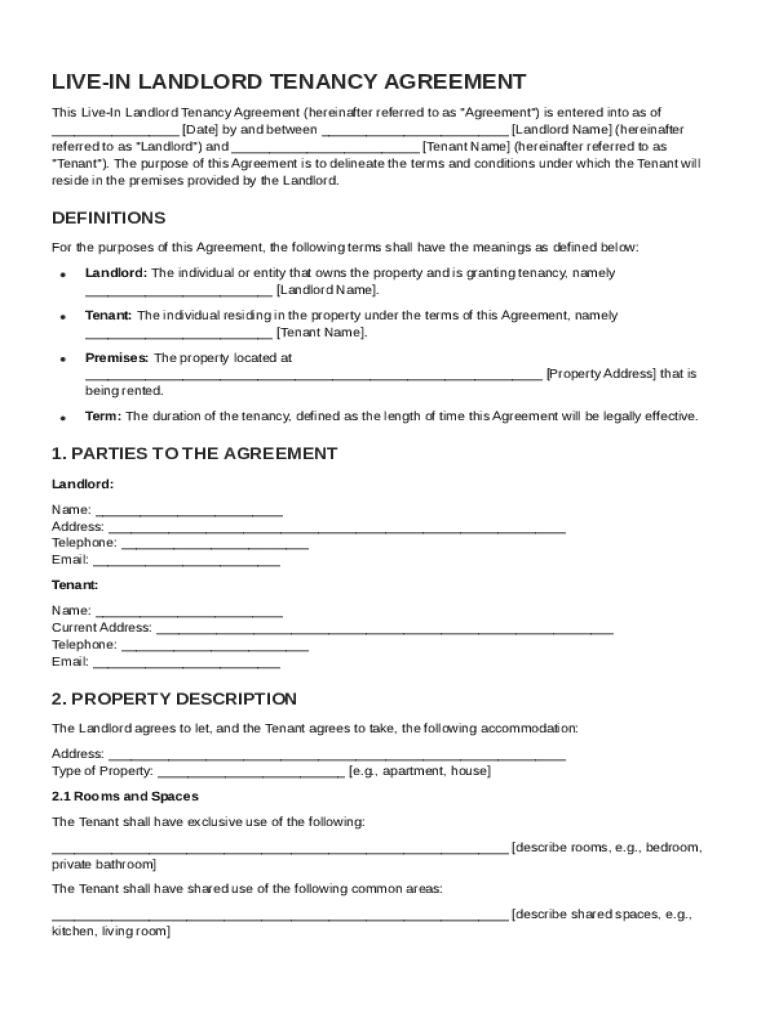
Tenancy Live In Landlord Agreement Form
Use a Tenancy Live In Landlord Agreement Template template to make your document workflow more streamlined.
What the tenancy agreement form does
A Tenancy Live In Landlord Agreement Form records the terms under which a landlord permits a tenant to live on or in the landlord’s property. It identifies the parties, premises, occupancy arrangement, rent or other consideration, responsibilities, duration, and signatures. The form creates a written record for reviewing agreed duties and resolving disputes, but state landlord-tenant law controls enforceability. signNow lets the parties upload the form, place fields, send it for electronic signatures, and retain the completed document with its audit trail when ESIGN and applicable state law requirements are satisfied.
Businesses that use tenancy agreements
The form supports property owners and housing teams whose live-in arrangements require clear terms, identified signers, and retrievable signing evidence.
Independent landlords can prepare one agreement for a specific property, then collect remote signatures while keeping occupancy dates, payment terms, and maintenance responsibilities in one auditable record. Property management firms can route separate live-in tenancy agreements to landlords and tenants, use reusable templates, and maintain role-based access across multiple properties without combining unrelated occupant records. Large housing operators can connect tenancy workflows with approved systems, apply administrator permissions, and preserve signed agreements and audit trails consistently across property teams and regional operations.
These tasks are executed by both individual contributors and centralized administrators depending on organizational policy and required controls.
Who uses this tenancy agreement form
Landlords and property owners
Landlords use the form to document a tenant’s permission to live in a property, rent or other consideration, utilities, maintenance duties, access rights, notice terms, and occupancy dates. Residential property owners should adapt these terms to applicable state and local landlord-tenant requirements before signing.
Live-in tenants
Tenants use the agreement to review the promised living arrangement before accepting occupancy. It can clarify private rooms, shared areas, payment obligations, household rules, repairs, termination procedures, and whether employment or another relationship affects the right to remain on the property.
How this tenancy form works online
The signNow workflow turns a prepared live-in tenancy agreement into a reviewable, signed record without changing the underlying property terms.
Upload form: Upload the landlord’s tenancy agreement PDF. Review fields: Auto-detect fields, then verify property-specific details. Send agreement: Send the agreement to each required signer. Preserve record: Store the signed file with its audit trail.
 Best ROI. Our customers achieve an average 7x ROI within the first six months.
 Scales with your use cases. From SMBs to mid-market, airSlate SignNow delivers results for businesses of all sizes.
 Intuitive UI and API. Sign and send documents from your apps in minutes.
Recommended tenancy agreement setup
Configure the tenancy agreement around signer identity, electronic consent, property-specific fields, audit evidence, and the retention rule applicable to the underlying record.
| Setting | Recommendation |
|---|---|
| Authentication method | Email verification with SMS code |
| Signature type | Electronic signature with signer consent |
| Audit trail | Enabled for every agreement |
| Document retention | Follow applicable state record policy |
| Encryption | TLS 1.2/1.3 and AES-256 |
How the tenancy audit trail works
The audit trail records who handled the tenancy agreement, when actions occurred, and which completed record supports the signed transaction.
Authenticate signers:
Capture timestamps:
Hash document:
Seal record:
Log actions:
Retrieve evidence:



Best practices for completing the agreement
Accurate party details, clear live-in terms, and preserved signing evidence reduce disputes over occupancy and responsibilities.
Identify every party and property clearly
Describe live-in conditions precisely
Capture informed electronic consent
Archive the signed record securely
State rules and document limits
Notary requirement
Wills and codicils
Family law orders
Real-estate deeds
Legal standing of electronic tenancy records
A signed tenancy agreement may be enforceable when the parties show intent, consent to electronic records, attribution, and reliable retention and reproduction. ESIGN, 15 U.S.C. ch. 96, and applicable state electronic-transactions law support electronic signatures, but exclude wills, certain court filings, family-law decrees, and other listed records. State landlord-tenant law still controls the agreement’s substantive terms.

Processing stages for the tenancy agreement
Use these four stages to move the live-in tenancy agreement from preparation through signed-record storage without omitting property-specific terms.
Prepare the agreement
Deliver to signers
Complete signer review
Archive completed record
Tenancy agreement troubleshooting questions
Resolve field, consent, authentication, plan, and state-law questions before relying on a signed live-in tenancy agreement.
Upload the original PDF or document again, then use signNow’s field tools to place required landlord and tenant fields manually. Check that names, property address, occupancy dates, payment terms, and signature locations are visible before sending the agreement.
The Business plan includes templates, legally binding eSignatures, and audit trails at $8/user/month with annual billing. Create a reusable tenancy template after confirming the landlord, tenant, property, and variable-term fields are correctly mapped.
Business Premium adds bulk send at $15/user/month with annual billing, but bulk sending is suitable only when each agreement uses the same structure. Review every property-specific address, rent term, occupancy condition, and signer before dispatch.
For a consumer-facing electronic tenancy record, provide the ESIGN disclosure required by 15 U.S.C. §7001(c), including paper-copy rights, electronic access, and withdrawal procedures. signNow can capture the signed record and audit trail; legal compliance remains fact-specific.
Use stronger signer authentication when identity disputes would materially affect occupancy rights. signNow supports advanced signer authentication on Enterprise, while SMS or other available methods should match the parties, property risk, and applicable policy.
Electronic signing does not replace a state-required notarization, recording, witness process, or special disclosure. Check the property state’s landlord-tenant and real-estate rules, then use signNow only for the portion legally eligible for electronic completion.
Key performance indicators that demonstrate SignNow's proven track record.
BE READY TO GET MORE
Get this form now!

If you believe that this page should be taken down, please follow our DMCA take-down process.