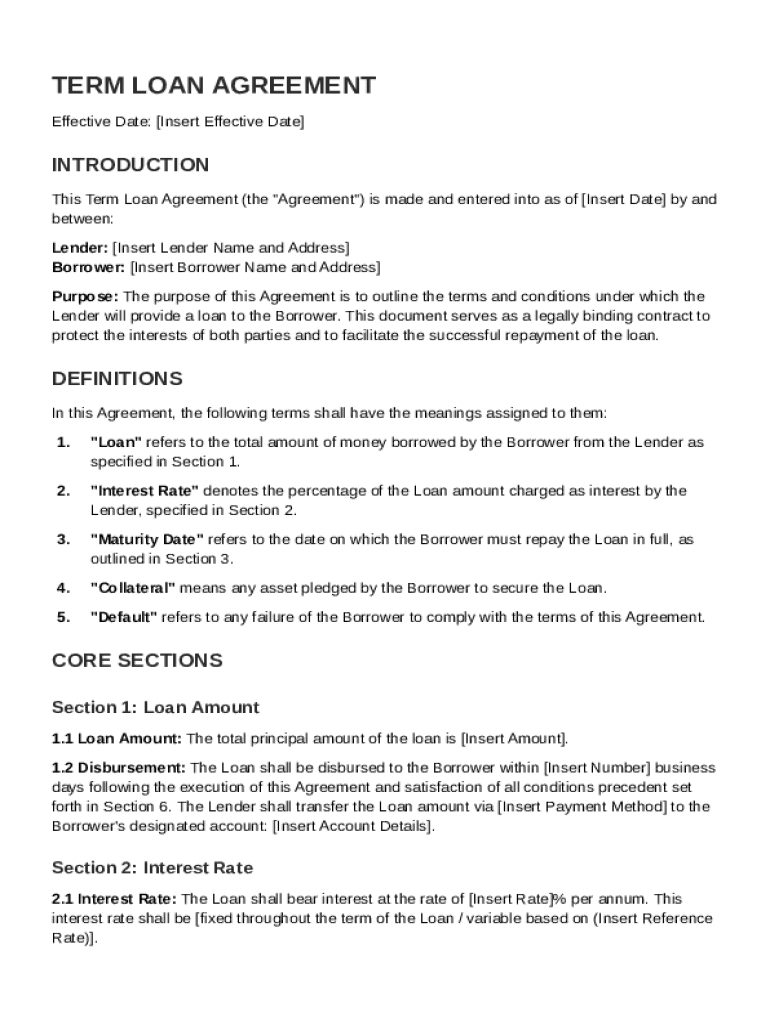
Term Loan Agreement Form
Use a Term Loan Agreement Template template to make your document workflow more streamlined.
What a term loan agreement form does
A Term Loan Agreement Form records a lender’s commitment to advance a defined principal amount and a borrower’s promise to repay it under stated terms. It normally identifies the parties, loan amount, interest rate, payment schedule, maturity date, fees, collateral or guarantees, representations, covenants, default remedies, and governing law. The parties review the completed terms, sign the agreement, and retain the executed copy with supporting schedules. In the United States, electronic execution may be recognized under the ESIGN Act and applicable state law, but transaction-specific exclusions and lending requirements still require legal review.
Features for completing loan agreements
A Term Loan Agreement Form needs accurate financial terms, controlled signing, and durable evidence that the final agreement was executed by the intended parties.
Structured loan terms
Capture the principal, interest rate, maturity date, payment frequency, late charges, and prepayment terms in a structured agreement that gives both parties a consistent reference.
Mapped signing fields
Place borrower, lender, guarantor, initials, date, and acknowledgment fields directly on the uploaded agreement so each required participant completes the correct section.
Signing order
Send the completed term loan agreement to multiple parties in a defined signing order, reducing uncertainty about whether lender, borrower, or guarantor acts next.
Audit trail
Preserve the final signed PDF with timestamps, signer activity, and completion evidence so the parties can retrieve execution records when servicing or reviewing the loan.
Reusable templates
Use reusable templates for recurring term loans while keeping transaction-specific principal amounts, schedules, collateral descriptions, and borrower information editable before each send.
Mobile signing
Allow borrowers and lenders to review and sign from supported desktop or mobile experiences, avoiding unnecessary in-person exchanges for transactions eligible for electronic execution.
How the loan agreement workflow works
Complete the Term Loan Agreement Form in four controlled stages, from document preparation through preservation of the executed record.
Upload: Upload the agreement PDF Check fields: Review detected financial and signature fields Assign signers: Assign lender and borrower roles Complete: Send, sign, and archive evidence
What the audit trail records
The audit trail connects each Term Loan Agreement Form signature to the identity, timing, document history, and completion evidence needed for later review.
Authenticate signer:
Capture timestamps:
Hash document:
Seal execution:
Build audit trail:
Export evidence:
 Best ROI. Our customers achieve an average 7x ROI within the first six months.
 Scales with your use cases. From SMBs to mid-market, airSlate SignNow delivers results for businesses of all sizes.
 Intuitive UI and API. Sign and send documents from your apps in minutes.



Recommended setup for loan agreements
Configure the signing workflow around borrower identity, accurate repayment terms, execution evidence, and controlled access to financial records.
| Setting | Recommendation |
|---|---|
| Authentication method | Email verification with SMS OTP |
| Signature type | Typed or drawn electronic signature |
| Audit trail | Export certificate and action history |
| Document retention | Retain through loan servicing and applicable law |
| Encryption | TLS 1.2/1.3 and AES-256 |
Record-keeping practices for loan agreements
Preserve the signed agreement, payment terms, and evidence of execution as one controlled record throughout the loan relationship.
Separate loan records from tax records
Export the audit trail after signing
Secure financial records in archival storage
Apply the longest applicable retention rule
Risks of incomplete loan execution
Weak signer attribution
Incomplete payment terms
Missing audit trail
Unrecorded electronic consent
Pricing and features for loan workflows
Compare verified signNow plan details with competitor information that was not verified in the available product reference.
| Features | Features | signNow | DocuSign | Adobe Sign | PandaDoc | Dropbox Sign |
|---|---|---|---|---|---|---|
| Starting price | $8/user/month annually | Not verified | Not verified | Not verified | Not verified | |
| Free trial | 7 days, no card | Not verified | Not verified | Not verified | Not verified | |
| Bulk sending | Business Premium | Not verified | Not verified | Not verified | Not verified | |
| Audit trails | Included | Not verified | Not verified | Not verified | Not verified | |
| HIPAA compliance | BAA required | Not verified | Not verified | Not verified | Not verified |
Legal standing of electronic loan agreements
A properly executed electronic Term Loan Agreement Form can be evidence of assent when the parties demonstrate intent, consent, attribution, and reliable record retention under the ESIGN Act and applicable UETA or New York ESRA rules. Wills, codicils, testamentary trusts, court orders, and family law decrees remain outside these ordinary electronic-signature rules.

Key performance indicators that demonstrate SignNow's proven track record.
Troubleshooting term loan agreements
Resolve field, signing, legal-validity, and record-preservation issues before the executed agreement enters loan servicing.
Upload the source PDF again and confirm that required fields are visible before sending. signNow can detect fillable fields, but review every principal, interest, payment, collateral, and signature field manually because loan-specific placement controls the executed document.
Use signNow’s signing-order controls to assign lender, borrower, and guarantor roles before sending. If the order is wrong, void the pending request and resend with the contractual sequence rather than asking parties to sign an incorrect workflow.
Business includes legally binding eSignatures, templates, and audit trails. Business Premium adds bulk send and kiosk mode, while Enterprise adds advanced signer authentication. Select the plan based on the agreement volume and identity controls required.
The ESIGN Act, 15 U.S.C. chapter 96, generally recognizes electronic signatures for interstate commerce, while UETA or New York ESRA may govern intrastate transactions. Confirm consent, signer attribution, record access, and any state-law exceptions before relying on electronic execution.
For a consumer-facing loan transaction, provide the required ESIGN consumer disclosure, demonstrate access to electronic records, and explain how consent may be withdrawn under 15 U.S.C. §7001(c). Retain the disclosure and consent evidence with the signed agreement.
Business plans include audit trails, while Site License adds full API access and can add HIPAA or 21 CFR Part 11 controls. Keep the signed agreement and completion certificate together, and verify any regulated workflow requirements before sending.
BE READY TO GET MORE
Get this form now!

If you believe that this page should be taken down, please follow our DMCA take-down process.