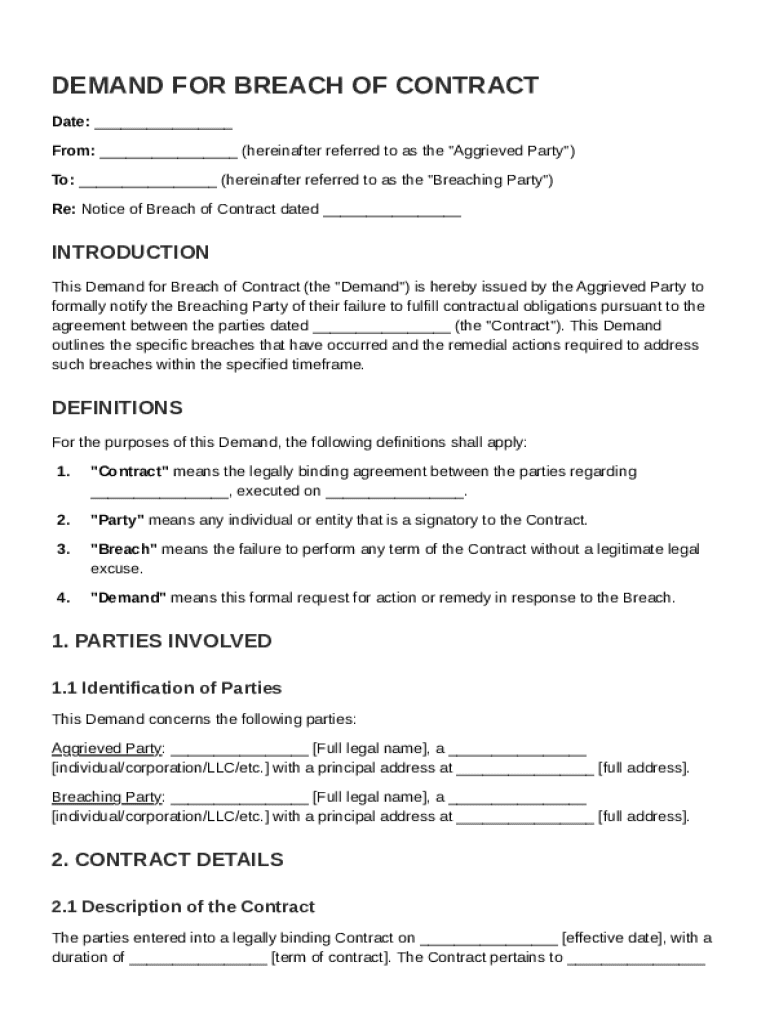
Demand Breach Of Contract Form
Use a Demand Breach Of Contract Template template to make your document workflow more streamlined.
What a breach demand form does
A Demand Breach Of Contract Form is a written notice that identifies an agreement, explains the other party’s failure to perform, and requests a defined cure or remedy. It usually names the parties, contract date, breached duties, relevant dates, supporting facts, requested action, response deadline, and sender contact details. After reviewing the contract’s notice clause and applicable state law, a sender can upload the demand to signNow, complete fields, route it for signature, and retain the executed document with its audit trail. The form does not itself decide liability or replace legal advice.
Who benefits from a breach demand workflow
The form is useful wherever a written contract requires documented notice, a cure request, or a clear record before escalation.
Solo attorneys can prepare a contract-specific demand, attach supporting records, and obtain an attributable signature without coordinating paper circulation for each dispute. Property managers and construction firms can document missed performance, request cure, and preserve delivery evidence across leases, bids, and service agreements. Enterprise legal teams can route demands through controlled templates, role-based access, and connected contract systems while maintaining consistent audit records.
These tasks are executed by both individual contributors and centralized administrators depending on organizational policy and required controls.
How a breach demand workflow works
A signNow workflow moves the demand from a prepared contract record to an attributable signed document with preserved delivery and audit evidence.
Upload documents: Upload the completed demand and supporting contract exhibits. Complete fields: Review detected fields and add recipient-specific information. Send for signature: Send through email or create a signing link. Preserve evidence: Store the signed demand with its audit trail.
Complete a breach demand in signNow
Use this sequence to prepare, send, sign, and preserve a Demand Breach Of Contract Form with its supporting contract evidence.
Prepare documents:
Upload the demand letter and contract exhibits. Review fields:
Check auto-detected fields and correct recipient details. Set recipients:
Add the intended signer and delivery instructions. Track completion:
Send and monitor the signing status.
 Best ROI. Our customers achieve an average 7x ROI within the first six months.
 Scales with your use cases. From SMBs to mid-market, airSlate SignNow delivers results for businesses of all sizes.
 Intuitive UI and API. Sign and send documents from your apps in minutes.
How the audit trail preserves evidence
For a breach demand, the audit trail connects signer identity, document integrity, and delivery events so the executed record can be reviewed later.
Signer authentication:
Timestamp capture:
Document hashing:
Tamper-evident sealing:
Action history:
Audit export:
Recommended breach demand setup
Configure the demand workflow around attributable signing, preserved evidence, controlled access, and the retention policy for the underlying contract dispute.
| Setting | Recommended configuration |
|---|---|
| Authentication method | Email verification with SMS 2FA |
| Signature type | Typed or drawn electronic signature |
| Audit trail | Detailed completion certificate |
| Document retention | Matter policy with legal hold |
| Encryption | AES-256 at rest and TLS 1.2/1.3 |
Legal standing of a signed demand
A breach demand can be evidence of notice when the sender shows intent, recipient attribution, reliable delivery, and an accurate retained record. ESIGN and UETA generally recognize qualifying electronic signatures, but exclude wills, court orders, and certain family-law documents; contract terms and state law still control notice and remedies.

Security for breach demand records
Data encryption:
Transport security:
Security certification:
Information security:
Privacy controls:
Evidence records:



Best practices for a breach demand
A precise demand connects the contract language, documented breach, requested cure, and delivery evidence without overstating the legal position.
Describe the breach and requested cure
Follow the contract’s notice requirements
Review facts before sending
Preserve the complete evidence file
Challenges when preparing a breach demand
Omitting the contract clause, performance date, or required notice method can make the demand difficult to evaluate and weaken proof that contractual notice was satisfied. Demanding an unsupported amount or cure period may create credibility problems, invite a counterclaim, or conflict with the agreement’s damages and dispute-resolution provisions. Sending the demand to the wrong legal entity, address, or designated notice recipient can delay cure and create a dispute over whether notice was effective. Editing the signed demand or separating attachments from delivery evidence can make it harder to prove exactly what the recipient received.
Risks from an inaccurate demand
Notice defect
Unsupported damages
Missing delivery proof
Contractual remedy conflict
Demand breach form troubleshooting
Use these answers to resolve signing, notice, authentication, plan, and evidence questions before relying on a completed demand.
Check the recipient email, signing order, and required fields before resending. signNow Business includes templates and audit trails; confirm the signer opens the current invitation rather than an expired or previously completed message.
Review the completed document and audit trail before treating it as evidence. signNow records signing events and timestamps, while ESIGN and UETA require intent, attribution, consent, and a record capable of accurate later reproduction.
Business is listed at $8/user/month with annual billing and includes audit trails, templates, and mobile apps. Business Premium is $15/user/month annually and adds bulk send and kiosk mode; month-to-month pricing is higher.
Use a signer authentication method appropriate to the dispute, such as email verification or SMS two-factor authentication. For consumer-facing records, consider the ESIGN consumer disclosure requirements under 15 U.S.C. §7001(c).
Do not assume a signed demand changes the contract’s notice or cure period. Compare the form with the agreement, applicable state law, and any required delivery method before relying on the response deadline.
Export and retain the signed demand, attachments, completion certificate, and delivery evidence together. Limit editing access after completion and follow the organization’s matter-retention or legal-hold policy for the dispute.
Key performance indicators that demonstrate SignNow's proven track record.
BE READY TO GET MORE
Get this form now!

If you believe that this page should be taken down, please follow our DMCA take-down process.