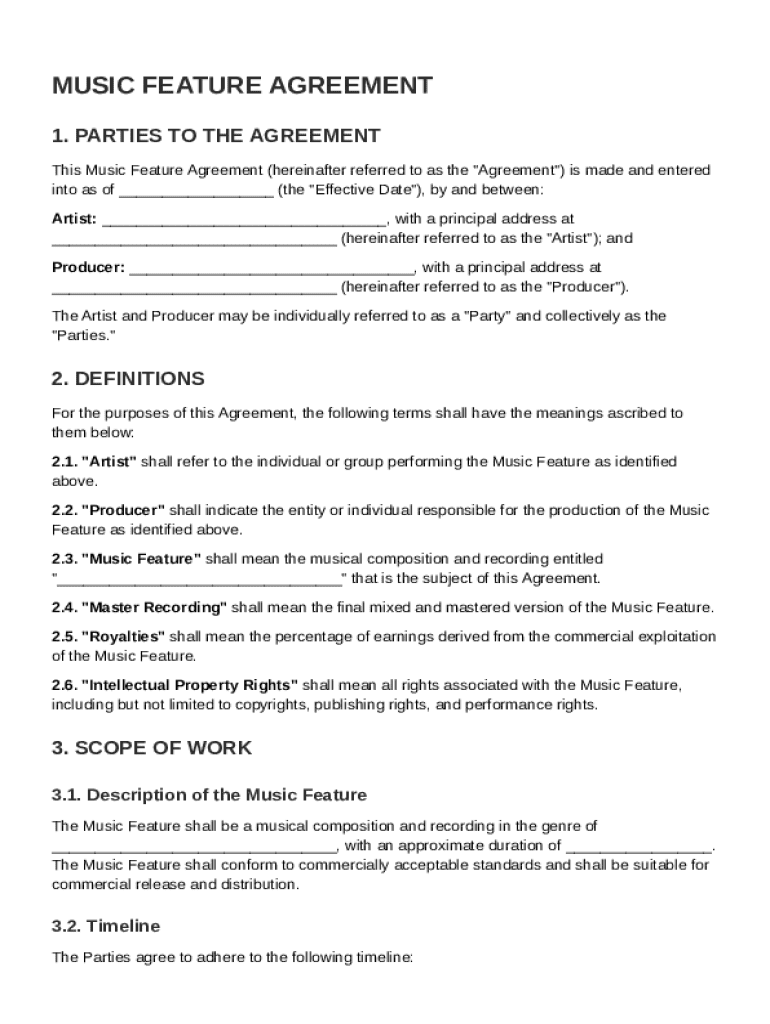
Music Feature Contract Form
Use a Music Feature Contract Template template to make your document workflow more streamlined.
What this music contract form does
Music Feature Contract Form is a business agreement used to record the terms under which an artist contributes to a musical work or recording. It can identify the parties, featured performance, compensation, credits, permissions, ownership, delivery requirements, approvals, and signatures. With signNow, upload the contract, review detected fillable fields, assign fields to the artist, producer, label, or other participants, then send it for signing. Each signer reviews the same controlled document, completes assigned fields, and receives a final copy with a certificate of completion and audit trail.
Who uses this music contract form
Artists and producers
Independent artists and music producers use Music Feature Contract Form for feature agreements, split arrangements, release permissions, and payment terms. signNow lets each participant review the uploaded contract, complete assigned fields, sign electronically, and receive a completed copy with an audit trail. The workflow helps preserve each party’s stated obligations, rights, credit language, and approval record without requiring everyone to meet in person.
Music businesses
Record labels, publishers, studios, and entertainment agencies use Music Feature Contract Form for artist agreements, NDAs, HR forms, invoices, and consent forms. Teams can prepare a reusable template, assign roles, send documents in order, and monitor completion. Administrators can retain signed copies and audit records while delegated staff handle day-to-day sending for separate music projects.
Business types using music contracts
Music Feature Contract Form serves independent creators and larger music organizations with repeatable agreement workflows.
Independent music producers use the form to document featured-artist permissions, compensation, credits, delivery obligations, and approval of the final recording before release. Small recording studios use reusable templates for musician agreements, session releases, confidentiality terms, and payment acknowledgments across multiple production projects. Record labels and entertainment companies use role-based sending, audit trails, and delegated administration to coordinate agreements across artists, managers, producers, and legal teams.
These tasks are executed by both individual contributors and centralized administrators depending on organizational policy and required controls.
Legal standing for music agreements
A Music Feature Contract Form can support a U.S. business transaction when the parties show intent to sign, consent to electronic records, signer attribution, and reliable retention and reproduction. ESIGN, 15 U.S.C. ch. 96, and applicable state law, including UETA or New York ESRA, provide the framework; wills, codicils, testamentary trusts, and certain court filings remain excluded.

 Best ROI. Our customers achieve an average 7x ROI within the first six months.
 Scales with your use cases. From SMBs to mid-market, airSlate SignNow delivers results for businesses of all sizes.
 Intuitive UI and API. Sign and send documents from your apps in minutes.
Key features for music agreements
signNow organizes the Music Feature Contract Form from field preparation through signature, evidence capture, and project-level record storage.
Field detection
Upload the prepared Music Feature Contract Form and let signNow detect fillable areas before you assign signatures, dates, initials, and project-specific terms.
Role assignment
Assign separate fields to artists, producers, labels, managers, or legal reviewers so every participant completes the obligations relevant to their role.
Remote signing
Send the agreement by email or signing link, allowing participants to review the feature terms without coordinating an in-person meeting.
Audit trail
Capture timestamps, signer activity, and document history so the completed contract has supporting evidence beyond a visible signature.
Reusable templates
Reuse an approved music agreement template while updating the recording title, contribution, compensation, credits, and permissions for each project.
Controlled records
Connect completed contracts to project records and preserve the signed PDF with its completion certificate for later rights or payment review.
Recommended workflow setup
Configure Music Feature Contract Form around identifiable signers, controlled access, preserved audit evidence, and project-based archival.
| Setting | Recommendation |
|---|---|
| Authentication method | Email verification with SMS OTP |
| Signature type | Electronic signature with signer intent |
| Audit trail | Retain certificate and completion history |
| Document retention | Archive by project and legal purpose |
| Encryption | TLS 1.2/1.3 and AES-256 |
How to complete the music contract
Prepare the agreement’s parties, recording details, compensation, credits, permissions, and approval terms before sending it for signature.
Upload document:
Upload the completed Music Feature Contract Form PDF. Check fields:
Review detected fields and add missing signature, date, or initials fields. Assign roles:
Assign each field to the artist, producer, label, or other signer. Send contract:
Send the agreement and monitor its signing status. Archive records:
Download the signed contract and audit trail after completion.
How the audit trail records signing
The signNow audit trail connects each Music Feature Contract Form signature with identity, timing, document integrity, and retrievable completion evidence.
Authenticate signer:
Capture timestamps:
Hash document:
Seal record:
Log activity:
Export evidence:



Security for signed music contracts
Transport encryption:
Storage encryption:
Security certification:
Management standard:
Health data controls:
Electronic signatures:
Challenges with music feature agreements
Unclear ownership language can leave artists, producers, and labels disputing recording rights, publishing interests, or permitted uses after signing. Missing compensation, credit, delivery, or approval fields can make a feature agreement incomplete for the specific recording project. Sending the wrong signer role or signing order can produce a contract without the approvals required by the label or production team. A signed copy stored without its audit trail can make later proof of identity, consent, timestamps, or document history harder.
Record-keeping practices for music contracts
Preserve the signed agreement, audit evidence, and related project records according to the document’s business and legal purpose.
Match retention to the record’s legal purpose
Export the contract and audit trail
Use secure archival storage
Check state rules and legal holds
Troubleshooting music contract signing
These answers address field assignment, signer access, electronic-signature validity, plan limits, privacy, and evidence for Music Feature Contract Form.
On the Business plan, upload the Music Feature Contract Form and review the detected fillable areas before sending. Add missing signature, date, initials, or text fields manually, then assign every field to a named signer. This prevents an agreement from reaching participants with incomplete project terms.
A signer can open the invitation without a signNow account when the sender’s workflow permits guest access. If stronger attribution is needed, configure authentication such as SMS OTP or another available signer verification method before sending the agreement.
Electronic signing can satisfy ESIGN and UETA requirements when the signer demonstrates intent, consents to electronic records, can be attributed, and the record remains reproducible. Consumer-facing transactions may also require the disclosure and access steps in 15 U.S.C. §7001(c).
Business includes legally binding eSignatures, templates, mobile apps, and audit trails at $8/user/month with annual billing. It includes 100 signature invites per user per year, with overage fees; Business Premium adds bulk send and kiosk mode at $15/user/month annually.
If the contract includes protected health information for a healthcare production or participant, confirm the required HIPAA configuration and business associate agreement. signNow identifies HIPAA compliance as requiring a BAA; a music agreement alone does not make a workflow HIPAA-regulated.
Open the completed transaction’s audit trail, verify the signer sequence and timestamps, and export the signed PDF with its certificate of completion. Preserve both files together so the signature event and final Music Feature Contract Form remain reproducible.
Key performance indicators that demonstrate SignNow's proven track record.
BE READY TO GET MORE
Get this form now!

If you believe that this page should be taken down, please follow our DMCA take-down process.