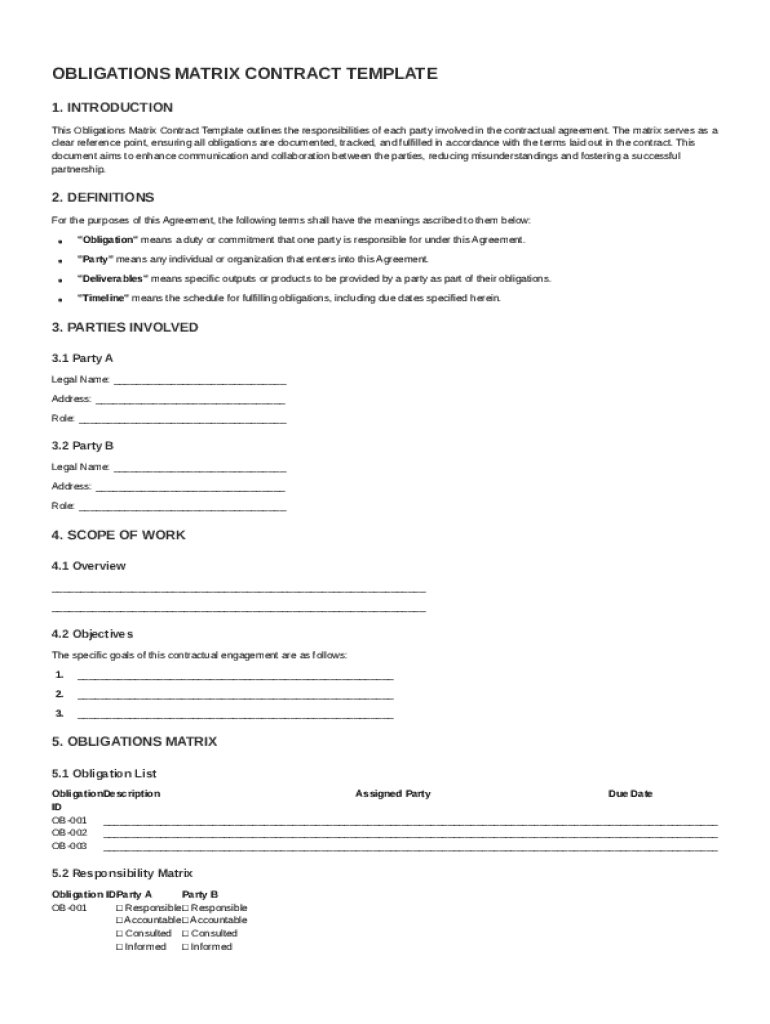
Obligations Matrix Contract Form
Use a Obligations Matrix Contract Template template to make your document workflow more streamlined.
What the obligations matrix does
An Obligations Matrix Contract Form records who accepts each contractual duty, what completion requires, and how performance will be evidenced. It is not a federal tax or agency form; its fields should be tailored to the parties’ agreement, including obligation descriptions, owners, deadlines, evidence, approvals, and signatures. In signNow, upload the matrix, review detected fillable fields, assign each field to its responsible participant, route the document, and retain the completed PDF with its audit trail. ESIGN and applicable state law govern electronic execution when intent, consent, attribution, and reproducible records are present.
Who benefits from this matrix
The form is useful when several parties must accept distinct duties and preserve evidence of responsibility.
Independent consultants can document client deliverables, acceptance criteria, and payment-related responsibilities before beginning a project, keeping each obligation tied to an identified signer and completion record. Healthcare organizations can route patient, provider, or vendor obligations when PHI is involved, subject to a BAA, access controls, and HIPAA’s six-year documentation rule. Enterprise procurement teams can assign supplier obligations across departments, use reusable templates, and preserve a searchable signature record for audits, renewals, and disputes.
These tasks are executed by both individual contributors and centralized administrators depending on organizational policy and required controls.
Who completes this contract matrix
Contract teams
Contract managers use the matrix to assign deliverables, approval owners, due dates, and evidence requirements before execution.
Operations teams
Operations and compliance teams track accepted obligations, preserve signed records, and review exceptions across departments.
Complete the obligations matrix online
Use signNow to convert the matrix into a routed, auditable signature workflow.
Upload form:
Upload the blank Obligations Matrix Contract Form to signNow. Check fields:
Review detected fields and add missing obligation fields. Assign signers:
Assign each obligation to the responsible signer. Send document:
Send the completed routing for electronic signatures. Archive records:
Store the signed PDF and audit trail together.
Review the audit trail evidence
The audit trail preserves signer identity evidence and document events so each matrix approval can be reviewed after completion.
Authenticate signer:
Capture timestamp:
Hash document:
Seal record:
Log actions:
Retrieve evidence:
 Best ROI. Our customers achieve an average 7x ROI within the first six months.
 Scales with your use cases. From SMBs to mid-market, airSlate SignNow delivers results for businesses of all sizes.
 Intuitive UI and API. Sign and send documents from your apps in minutes.
Recommended setup for this contract form
Configure signing controls around signer identity, evidence, access, and the retention rule governing each completed obligation.
| Setting | Recommendation |
|---|---|
| Authentication method | Email verification with SMS OTP |
| Signature type | Intent-based electronic signature |
| Audit trail | Capture IP, timestamps, and signer actions |
| Document retention | Retain according to applicable record rules |
| Encryption | TLS 1.2 or 1.3 and AES-256 |
Processing stages for this form
The workflow moves from field preparation through signer completion and evidence preservation; signer turnaround depends on participant response.
Prepare the document
Deliver to signers
Collect signatures
Archive the record
Privacy and disclosure pitfalls
Personal information placed in obligation descriptions can remain visible to every recipient instead of only the responsible signer. A consumer-facing workflow may require ESIGN consent disclosures before electronic delivery and signature. Overbroad workspace permissions can let users edit, download, or resend the matrix without authorization. Unassigned rows can create uncertainty about who accepted an obligation and when that acceptance occurred.
Risks from incomplete execution
Electronic consent
Signer identity
Document integrity
Audit record
Acceptance dispute
Legal standing of the completed matrix
An electronically signed Obligations Matrix Contract Form can support a U.S. business record when the parties show intent, consent, attribution, and reliable retention under ESIGN and applicable state law. Wills, court orders, and certain family-law documents remain outside ESIGN’s coverage.

Best practices for matrix execution
Accurate assignments, controlled edits, and complete evidence make the signed obligations matrix easier to administer and review.
Separate obligations by accountable owner
Assign every field before sending
Check the completed document
Preserve the execution record
Platform requirements for signing
Complete the Obligations Matrix Contract Form in signNow using Chrome, Firefox, Safari, or Edge on Windows or macOS. The signNow mobile apps support iOS and Android for reviewing and signing assigned fields.
Browsers Chrome, Firefox, Safari, Edge Desktop systems Windows and macOS desktops Mobile apps iOS and Android signNow apps
Teams with regulated or high-volume workflows should confirm managed-device policies, identity controls, and storage permissions before deployment. Enterprise configurations may also require SSO, API access, or additional authentication controls for the people assigning and approving obligations.



Key performance indicators that demonstrate SignNow's proven track record.
Troubleshooting the obligations matrix
Resolve field, authentication, plan, legal, and retention questions before treating the signed matrix as an enforceable business record.
Upload the matrix to signNow, review automatically detected fields, and add any missing obligation, date, initials, or signature fields manually. The Business plan includes templates and audit trails; verify field assignment before sending.
Use SMS OTP or another available signer-authentication method, then review the audit trail for the authentication event. Stronger authentication may depend on the selected signNow plan and configured workflow.
Electronic execution generally requires intent, consent, attribution, and a record that can be retained and reproduced. ESIGN, 15 U.S.C. §7001, and applicable state law govern the analysis.
A seven-day signNow trial is available without a credit card. Afterward, the Business plan is listed at $8 per user per month with annual billing; plan limits and invite usage still apply.
Business Premium includes bulk send, while Enterprise adds advanced signer authentication, formula fields, and conditional fields. Choose the feature only when the matrix workflow requires it.
For PHI-related obligations, signNow identifies HIPAA compliance as requiring a BAA. Retain the documentation six years from creation or the last effective date under 45 CFR §164.530(j).
BE READY TO GET MORE
Get this form now!

If you believe that this page should be taken down, please follow our DMCA take-down process.