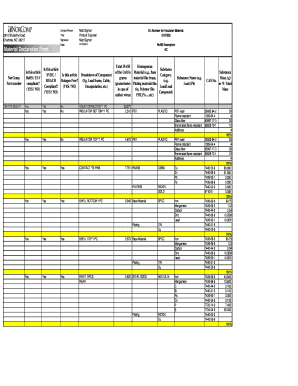
Full Material Declaration Form
Use a Full Material Declaration Template template to make your document workflow more streamlined.
What the Full Material Declaration Form does
A Full Material Declaration Form records the materials and substances present in a supplied component so procurement, engineering, and compliance teams can review one identified part. It usually links the declaration to a supplier, component number, revision, material composition, and signer. With signNow, upload the approved PDF, allow fillable-field detection, add supplier and internal reviewer roles, send the form for signatures, and retain the completed document with its audit trail. The form is a supplier declaration, not an IRS, USCIS, or federally standardized filing, so customers should follow their contractual or industry-specific requirements.
Who uses this material declaration
Procurement
Procurement teams request supplier declarations, identify the relevant component and revision, and route completed records to engineering or compliance reviewers for approval.
Engineering and compliance
Engineering and compliance teams verify material composition, compare supplier submissions, and retain signed evidence connected to the component record and revision history.
How the declaration workflow works
The workflow moves one identified material declaration from supplier input through internal approval and documented storage.
Upload: Upload the approved material declaration PDF. Prepare: Detect or place supplier and reviewer fields. Route: Route the form to assigned recipients. Complete: Capture signatures and archive evidence.
How to complete the declaration
Prepare the approved material declaration, identify each signer, and preserve the completed record with its audit evidence.
Upload form:
Upload the approved declaration PDF. Detect fields:
Let signNow detect fillable fields. Assign roles:
Add supplier and reviewer roles. Send form:
Send the declaration for signatures. Archive record:
Store the completed PDF and audit trail.
What the audit trail records
The audit trail documents the identity, timing, integrity, and retrieval history of a completed Full Material Declaration Form.
Authenticate signer:
Capture timestamps:
Hash document:
Seal record:
Record actions:
Export evidence:
 Best ROI. Our customers achieve an average 7x ROI within the first six months.
 Scales with your use cases. From SMBs to mid-market, airSlate SignNow delivers results for businesses of all sizes.
 Intuitive UI and API. Sign and send documents from your apps in minutes.
Recommended declaration workflow setup
Configure the Full Material Declaration Form around supplier identity, controlled review, document integrity, and organization-specific retention requirements.
| Setting | Recommendation |
|---|---|
| Authentication method | Email link with SMS verification |
| Signature type | Electronic signature with signer intent |
| Audit trail | Enabled for every completed declaration |
| Document retention | Follow contract and industry requirements |
| Encryption | TLS 1.2/1.3 and AES-256 |
Features that support material declarations
Full Material Declaration Form workflows combine structured supplier input, sequential review, eSignatures, audit evidence, and connected document storage.
Reusable template
Upload the approved Full Material Declaration Form and keep supplier, component, and revision information in one repeatable document structure for each submission.
Role-based routing
Assign supplier, engineering, and compliance roles so each person receives only the fields and signing responsibilities required for the declaration.
Field detection
Auto-detect fillable fields after upload, reducing manual preparation when converting an existing material declaration into a signable workflow.
Audit trail
Capture timestamps, signer actions, and document history so reviewers can understand how the final declaration was completed and approved.
Mobile signing
Use mobile apps when supplier or field personnel need to review and sign material information away from a desktop workstation.
Business integrations
Connect completed declarations with systems such as NetSuite, Salesforce, Google Drive, Box, or Procore for coordinated records management.



Platform requirements for material declarations
Use the Full Material Declaration Form in Chrome, Firefox, Safari, or Edge on Windows or macOS. signNow also provides iOS and Android mobile apps for reviewing and signing supplier declarations.
Browsers Chrome, Firefox, Safari, Edge Desktop systems Windows and macOS desktop access Mobile apps iOS and Android signNow apps
Teams handling proprietary material information should manage access through defined signNow roles and approved devices. Enterprise workflows may require advanced signer authentication, while connected systems can support controlled storage and retrieval of completed declarations.
Security for material declarations
Transport encryption:
Stored encryption:
Security certification:
Control framework:
U.S. eSignatures:
Signer authentication:
Challenges when completing material declarations
Suppliers omit substance percentages or component identifiers, leaving engineering reviewers unable to confirm whether the declaration covers the specific part. Versioned forms create conflicting declarations when procurement teams send outdated templates without a controlled source document. Multiple reviewers sign in the wrong order, weakening the record of supplier submission and internal technical approval. Material declarations contain proprietary supplier information that requires controlled access, documented permissions, and secure storage after completion.
Best practices for material declarations
A controlled template, clear review order, and linked audit evidence make supplier declarations easier to verify and retrieve.
Use one controlled declaration template
Require component-level identification
Separate supplier and reviewer approval
Archive the signed record securely
Full Material Declaration Form in practice
Material declarations connect supplier composition information with procurement, engineering, and compliance review.
Technology distribution
Tech Data manages supplier and customer documentation across a global technology distribution workflow where accurate material information supports operational review.
- Supplier declarations remain organized
- Approvals follow defined responsibility
- Completed records support downstream review
Tech Data uses airSlate SignNow to improve internal and external customer service while increasing speed to revenue. For a Full Material Declaration Form workflow, a reusable template, assigned signers, and an exported audit trail can connect supplier information with a traceable approval record.
Electronics manufacturing
A U.S. electronics manufacturer collects completed material declarations from suppliers before procurement and engineering teams approve component records.
- Supplier data stays linked to components
- Reviewers receive the same form
- Audit evidence remains available
The manufacturer can upload the Full Material Declaration Form, let signNow detect fillable fields, route the document to supplier and internal reviewers, and retain the completed PDF with its audit trail. This reduces rekeying while preserving a record of who supplied and approved each declaration.
Troubleshooting material declaration workflows
Resolve field, routing, plan, and record-preservation issues with steps tied to the Full Material Declaration Form workflow.
Upload the approved PDF again and check whether the component identifiers, revision fields, and signature areas are actual form fields. signNow can detect fillable fields after upload, but unusual layouts may require manual field placement before sending.
The signNow Business plan includes templates and audit trails at $8/user/month when billed annually. If the workflow requires bulk send, Business Premium is listed at $15/user/month annually and includes that capability.
Use signNow role assignment to place the supplier before engineering or compliance reviewers. Check each recipient’s email address, signing order, and required fields before resending the Full Material Declaration Form.
signNow states that its eSignatures comply with ESIGN and UETA. For a material declaration, preserve signer intent, consent, attribution, the completed record, and the audit trail; contractual or sector requirements may add controls.
Export the completed declaration and its audit trail from signNow, then store both with the component identifier and revision. The Full Material Declaration Form has no universal federal retention period in the supplied authorities.
Business includes audit trails, while Enterprise adds advanced signer authentication and is listed at $30/user/month annually. Use stronger authentication when supplier identity or proprietary composition data requires additional access control.
Key performance indicators that demonstrate SignNow's proven track record.
BE READY TO GET MORE
Get this form now!

If you believe that this page should be taken down, please follow our DMCA take-down process.